How the RTX 3090 Actually Works: GPU Architecture notes...
I spent some time watching Branch Education's video on how GPUs work, specifically the RTX 3090, and took detailed notes. Figured I'd clean them up and share what I learned about the GA102 architecture.
The Hardware Breakdown
We're looking at GA102, which is the 3090's GPU processor architecture.
The Hierarchy
The architecture is organized in layers:
- 7 GPCs (Graphics Processing Clusters) at the top level
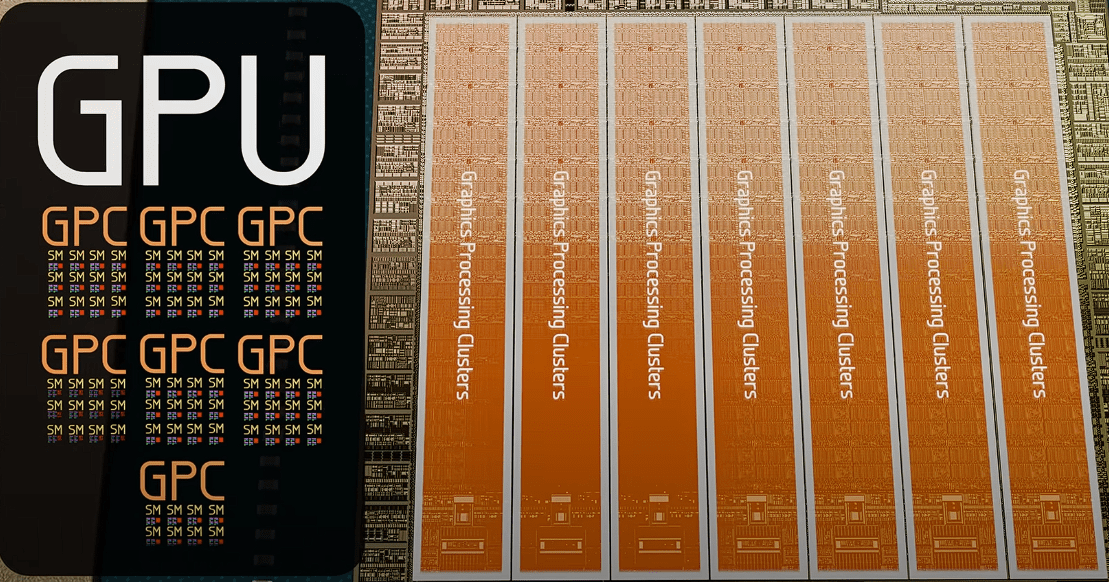
- Within each GPC, there are 12 SMs (Streaming Multiprocessors)

- Inside each SM, there are 4 warp schedulers and 1 Ray Tracing core
- Inside each warp, there are 32 CUDA cores (shading cores) and 1 Tensor core
Total Core Count
Across the entire GPU:
- 10,752 CUDA cores
- 336 Tensor cores
- 84 Ray Tracing cores
Around the Edge
The chip's periphery includes:
- 12 graphics memory controllers
- NVLink controllers
- PCIe interface
- 6MB Level 2 SRAM cache at the bottom
- Gigathread Engine that manages all 7 GPCs and the streaming multiprocessors inside
Inside Each SM
Each streaming multiprocessor contains:
- 128KB of L1 cache/shared memory (configurable split)
What Each Core Does
CUDA Cores
Can be thought of as simple binary calculators - they handle addition, multiplication, and a few other basic operations.
Tensor Cores
Matrix multiplication and addition calculators. They're used the most when working with geometrical transformations and neural networks.
Ray Tracing Cores
The fewest and the largest cores. They're specially designed for ray tracing algorithms.
Key Terminologies
FMA (Fused Multiply-Add)
The operation A × B + C. This is a fundamental calculation that gets used constantly in GPU operations.
SIMD (Single Instruction, Multiple Data)
GPUs solve embarrassingly parallel problems using SIMD - applying one instruction to multiple data points simultaneously.
SIMT (Single Instruction, Multiple Threads)
Basically SIMD but adds a program counter, which avoids conflicts from dependency and branching of operations.
Computational Architecture → Physical Hardware
Now that we understand how SIMD/SIMT works, here's how the computational architecture maps to the physical hardware:
- Each instruction is completed by a thread
- A thread is paired with a CUDA core
- Threads are bundled into groups of 32 called warps
- The same sequence of instructions are issued to all threads in a warp
- Warps are grouped into thread blocks, which are handled by a Streaming Multiprocessor (SM)
- Thread blocks are grouped into grids, which are computed across the entire GPU
All these operations are managed and scheduled by the Gigathread Engine, which maps the available thread blocks to the streaming multiprocessors.
@misc{kanade2025gpuarchite,
  author  = {Anurag Kanade},
  title   = {How the RTX 3090 Actually Works: GPU Architecture notes...},
  year    = {2025},
  url     = {https://anuragkanade.com/blog/gpu-architecture-notes},
  note    = {Blog post}
}